
For everyone left wondering after imaging day
The scan is over. The uncertainty doesn't have to be.
You waited months for that MRI. You deserve more than two minutes of jargon. JointLens reads your images with a consortium of top AI models and explains what they show — in plain language, within minutes, without your files leaving your browser.
- MRI, CT & X-ray reports explained
- Minutes, not weeks
- Files never leave your browser
- Multi-model consensus, per joint
- Independent read — not a diagnosis
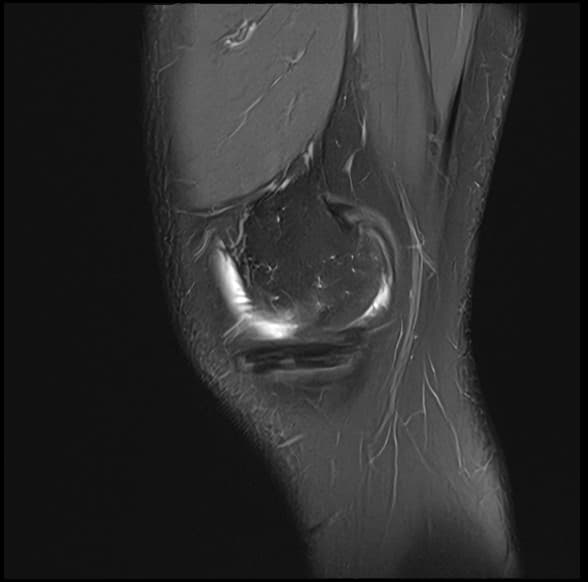
Knee joint · MRI
The real problem
Sounds familiar?
The scan was fast. The report wasn't.
Patients want imaging results within hours. In practice, reports take days or weeks — and over a third of people wait longer than two weeks, or chase a report that never arrives.
Everything is waiting on that report
The surgery date. The insurance claim. The specialist referral. They all sit behind one document in a radiology queue — while your life stays on hold.
The jargon wall
"Moderate effusion". "Signal changes". You get ten minutes with a doctor and a page of terms nobody explains — so you leave with more questions than you came with.
The 2 a.m. search spiral
Most MRI patients report anxiety after the scan — much of it driven by uncertainty. Forums make it louder, not clearer. Understanding your own images shouldn't feel like this.
What can actually be answered
The questions you have been carrying — and how yours get solved
"Is something actually torn?"
Ligament, tendon and meniscus findings are detected, graded and explained in context — not just listed.
"How much wear is there?"
Cartilage loss and osteoarthritis are staged clearly, so a word like "moderate" finally means something concrete.
"Is it healing?"
Compare a follow-up scan against an earlier one and see what changed between the two — in plain language.
"What did those words even mean?"
Every finding comes with a plain-language explanation you can read yourself — or hand to your doctor to start a better conversation.
From upload to understanding in minutes
Open your joint site
Pick a joint above and drop in your MRI, CT or X-ray — DICOM, ZIP or PDF.
Your scans stay yours
Files are parsed and rendered entirely in your browser. Nothing is stored on our servers.
Get a consensus report
The AI consortium returns a structured, explainable report you can bring to your doctor.
Not one AI opinion — a consensus
When something matters this much, you want more than a single take. Several frontier models review each scan independently; a synthesis step reconciles their findings into one independent, calibrated report — built to be handed to your doctor, not to replace them.
GPT-5.6 Sol
Frontier quantitative grading and measurement precision
Gemini 3.7 Flash
Deep multimodal spatial coverage and cross-series correlation
Claude Opus 5.5
Nuanced clinical reasoning and calibrated uncertainty
Grok 4.6
Fast direct image-grounded challenge review
Model line-up evolves as new frontier models are released.
Nine joints. One consortium.
Each joint has a dedicated site with the same privacy-first AI analysis. Pick yours.









Private by design
Your raw DICOM, ZIP and PDF files are parsed, rendered and viewed entirely in your browser. Only when you choose to run an analysis do rendered images travel to our stateless AI relay — never stored, never retained.
JointLens provides imaging analysis support only — it is not a medical diagnosis and does not replace professional medical advice.
Frequently asked questions
Is JointLens a replacement for a radiologist?
No. JointLens provides an independent AI-assisted review of your imaging to help you understand it — many patients use it as an AI second opinion alongside their doctor. It is not a medical diagnosis, and your doctor makes all clinical decisions.
Can JointLens reports be used for insurance or surgery claims?
Think of JointLens as clarity for you and a better starting point for the conversation with your doctor. Clinical decisions and official paperwork always stay with your treating physician.
Which file formats can I analyze?
DICOM files, ZIP archives of DICOM studies, and PDF reports are supported across MRI, CT, X-ray and CBCT imaging.
What does the AI consortium actually do?
Several frontier AI models review each scan independently. A synthesis step compares their findings and produces one calibrated report with confidence levels, so weak signals from any single model get filtered out.
Do my scans get uploaded or stored?
Your raw files are parsed and rendered entirely in your browser. Only when you choose to run an analysis do rendered images reach our stateless relay — they are never stored.
Which joints are supported?
Knee, ankle, shoulder, hip, spine, elbow, wrist, hand and dental — each with a dedicated site whose models and prompts are tuned for that anatomy.